

Objective
Monitoring computer systems in professional environments relies on Grafana dashboards (visual panels that display in real time the status of servers, applications, and services). However, creating them remains a slow and technically demanding task: it requires expertise in the monitoring domain, knowledge of the platform’s specific query language, and mastery of Grafana’s configuration format, which can extend the process to several hours even for relatively simple cases.
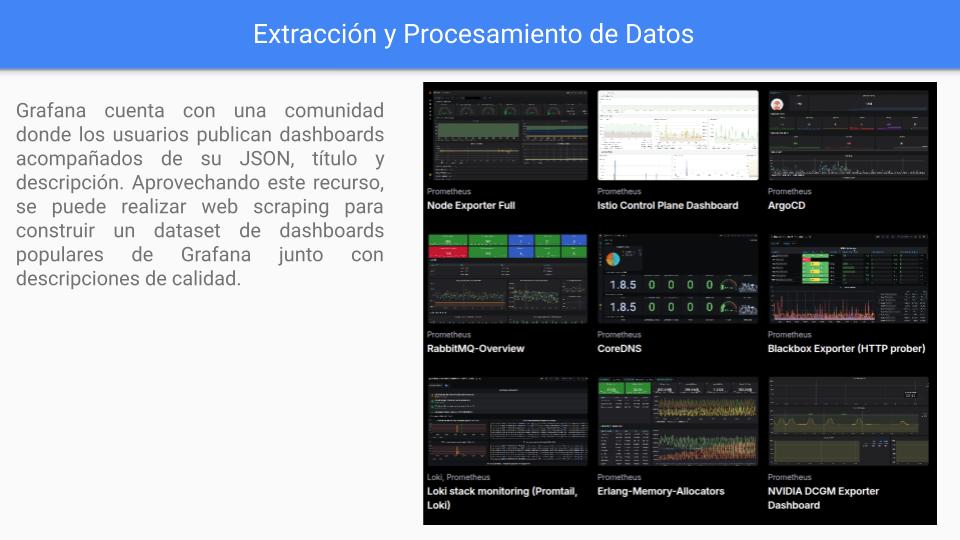
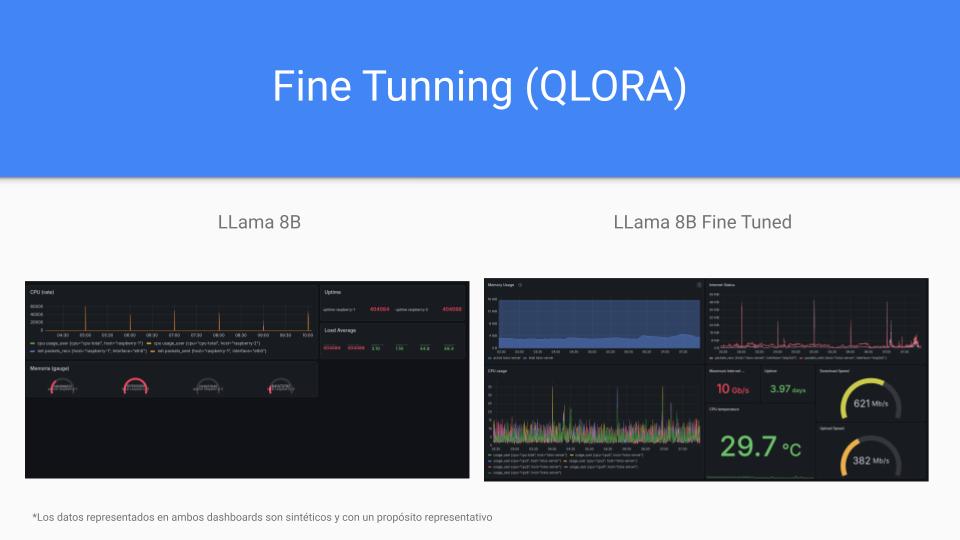
This project proposes automating that process using artificial intelligence. Starting from a simple natural language description, the system automatically generates the complete dashboard configuration, ready to be imported directly into Grafana. To achieve this, fine-tuning techniques are applied to an open-source language model, trained specifically on hundreds of real dashboards contributed by the Grafana community, so that the model learns the conventions and structure of the target format.
The system runs completely locally on proprietary hardware, without relying on external commercial artificial intelligence services, making it reproducible and suitable for environments with privacy requirements. The quality of the generated dashboards is evaluated automatically using a set of language models acting as judges, comparing the outputs of the fine-tuned model against the base, unadjusted model.
The specific objectives are:
– To build a training dataset from real dashboards contributed by the Grafana community.
– To develop an efficient fine-tuning pipeline that can be run on consumer-grade hardware without cloud infrastructure.
– To design a multi-judge automatic evaluation framework to assess the quality of the generated dashboards.
– To quantitatively compare the performance of the specialized model against the base, non-fine-tuned model.
– To analyze to what extent the system reduces the time required to obtain usable dashboards compared to manual creation.

BACHELOR’S THESIS BY
ALBERTO PENAS DÍAZ
Academic experience
- Degree in Computer Science and Engineering, Universidad Carlos III de Madrid (september 2021 – september 2026)
Work experience
Artificial Intelligence Researcher, Applied Artificial Intelligence Group (GIAA) · UC3M — Madrid, Spain (July 2025 – present)
– Fine-tuning large language models with QLoRA for structured output generation, targeting automated Grafana dashboard construction from natural-language clinical descriptions.
– Accepted oral presentation at IWINAC 2026 (Springer LNCS): Estimating MMSE Scores from Conversational Transcripts Using Quantized LLMs.
– Conducted systematic literature reviews on state-of-the-art ML, RL, and explainable AI methods to inform the design of clinically grounded AI frameworks.
Project Manager, Thinger.io — Madrid, Spain (May 2025 – present)
- Designed and developed hardware-specific firmware frameworks for IoT devices using MQTT, LoRaWAN, and NB-IoT protocols across heterogeneous device fleets.
- Collaborated with firmware engineering teams to integrate OTA update mechanisms with versioned image management and automatic rollback on failed flashing cycles.
- Monitored field device telemetry, identified throughput bottlenecks through performance profiling, and delivered targeted optimisations that measurably increased message throughput.
HPC Researcher — Number Theory & Supercomputation, Spanish National Research Council (CSIC) · PNRG Group — Madrid, Spain (Jan 2025 – May 2025)
- Developed high-performance algorithms in C++ for computational number theory, executed at scale on the HPC-DRAGO Spanish supercomputer.
- Implemented hybrid parallelism (MPI + OpenMP) for both distributed and shared-memory execution models, achieving significant reductions in wall-clock time for large-scale primality and factorisation workloads.
- Designed memory-efficient data structures to handle the volume and precision requirements of extended-range mathematical computations.